Why your journaling app makes you feel guilty after you miss a day
Have you ever stopped journaling because you missed a single day?
📚 Part of The Calm Guide to Daily Journaling, all our journaling guides in one place.
Most people think it is because they lack discipline.
It isn't.
Three days. That is how long the last journal lasted for a lot of people.
Day one feels exciting. Day two feels hopeful. Day three feels productive.
Then life happens. You miss a day. You open the app, and instead of a blank page it shows you this:
🔥 Your 3-day streak is gone.
You close it. And you do not open it again for weeks. Sound familiar?
If you have ever wondered why journaling apps make you feel guilty, here is the part that matters: you probably did not quit because you forgot, and you almost certainly did not quit because you lack discipline. You quit because of something almost every journaling app does. Once you notice it, you cannot unsee it.
The feature was never really about journaling
The streak was not built to help you reflect. It was built to bring you back.
That is not a conspiracy, it is just what a streak is for. Borrowed from language apps and games, a streak, a badge, and a "don't break your streak" reminder are retention mechanics: small design choices whose whole job is to get you to open the app again tomorrow.
🔔 Don't lose your streak!
On a game, that is a fair trade. You want to keep playing, and the nudge helps you keep playing. On a journal, it quietly turns into something else.
A streak quietly changes what success looks like. Instead of asking "did this help me reflect?", you start asking "did I keep the number alive?"
You miss a day. The app tells you that you failed.
It usually unfolds in five quiet steps:
You miss one day.
↓
The streak disappears.
↓
You feel behind.
↓
You promise yourself you'll start tomorrow.
↓
Tomorrow never comes.
The notebook slides into a folder on your phone, and every time you catch the icon you feel a small, familiar flicker of guilt.
It's not that writing is hard. It's that opening the app now feels like admitting you failed.
To be fair, none of this is malicious. Most teams are rewarded for keeping people coming back, and a streak is one of the easiest ways to do that. The problem is that what helps a game grow doesn't always help someone reflect on their life. The guilt is not something anyone set out to create. It is just what happens when you build a reflection tool the way you'd build a game.
A journal should remember your life, not judge it.
Why it hurts more than it should
Losing a seven-day streak stings far more than earning it ever felt good, and there is a reason for that.
Psychologists have known for decades that losing something hurts more than gaining the same thing feels good. A streak takes that instinct and points it straight at your journal. So the day you are too tired, too sad, or too busy to write, the day you most needed somewhere quiet to land, is the exact day the app makes you feel worst.
Ever notice this one?
You miss a day. The app says "You missed yesterday." So instead of writing something today, you start thinking about yesterday. Then you write neither.
The streak did its job. It pulled the number back to the top of your mind. The reflection was just the casualty.
Most people don't abandon journaling because writing is hard. They abandon it because coming back feels hard. Missing a day was never what ended a journal. Walking away for good was.
You can see the whole trap on a single page:
In short: because losing hurts more than gaining, a broken streak stings most on the exact day you most needed to write.
Why the missing pages don't matter
There is another version of this that almost every journal owner has lived through. You open the app after a week away, stare at the empty page, and think, "maybe I should write about the days I missed first." The task suddenly feels too big. So you close the app. Again. Nothing about that is a discipline problem; it is a design that made coming back feel like catching up.
But you never needed to catch up at all.
Imagine finding an old journal ten years from now. There are only six entries in it. Not six hundred. Just six.
One is about your first week at a new job. One is about a train ride you had completely forgotten. One is about your grandmother.
Those six pages are suddenly priceless. Not because you journaled consistently, but because you kept something that would otherwise have disappeared for good.
The missing pages don't matter. The ones that survived do.
This is the part a streak gets exactly backwards. It treats those six entries as a failed run, a broken number, a habit you couldn't keep. But nobody opens an old journal and feels sad about the days they skipped. You feel grateful for the days you caught.
A streak measures the days you missed. A journal keeps the days you didn't.
Those are not the same tool, and they were never meant to be.
The fix is not more willpower
It is not a smarter reminder either. It is removing the scoreboard.
When one line is allowed to count, there is nothing to keep up, so there is nothing to break. Miss a day and it is just a day you missed. You can write again today, with no penalty and no catch-up screen. This is the quiet case for minimalist journaling: the bar is one line, and it never treats daily journaling as pass or fail.
Try this tonight. Open whatever you write in. Write exactly one sentence about your day. Then stop.
If that feels strangely freeing, it is not because you suddenly found more discipline. It is because you took away the pressure to perform. Reflection was never meant to feel like homework.
What the people who keep journaling actually do
The people who keep a journaling habit for years mostly do not journal every day. They just never let a missed day convince them they had failed. When they wonder how to start journaling again, the answer is never a longer streak. It is simply the next blank line.
That is the whole trick. Not a longer streak. Permission to return.
The goal isn't to write every day. The goal is to always feel welcome back.
Permission is the opposite of pressure. A good journal doesn't ask you to prove you're consistent. It simply leaves the page open.
So if you are looking for a journal you will actually keep, look for what is missing:
- No streak, and no "you missed a day" message. A blank day should read as a blank page, not a red zero.
- One line is enough. It should feel complete whether you write a word or a page.
- Patterns without a score. Seeing the shape of your month is lovely; being graded on it is not.
- Reminders that invite, not warn. The tone is the tell.
Privacy, export, and honest pricing matter too, but that is its own checklist: the best free, private journal apps.
The journal we wanted to exist
We didn't start by asking how to build a better journaling app. We started by asking why so many of us, including our own team, kept abandoning them.
We build calm software at PurposeLab Studio, which means we spend a lot of time studying the opposite: the small mechanics that make an app hard to put down. Our founder spent about six years working on engagement and feed systems, where a design was often judged by one thing, whether it brought people back. That is exactly the machinery this whole article is about.
Somewhere along the way the question stopped being "how do we get people to journal every day?" and became "how do we help people feel okay coming back?"
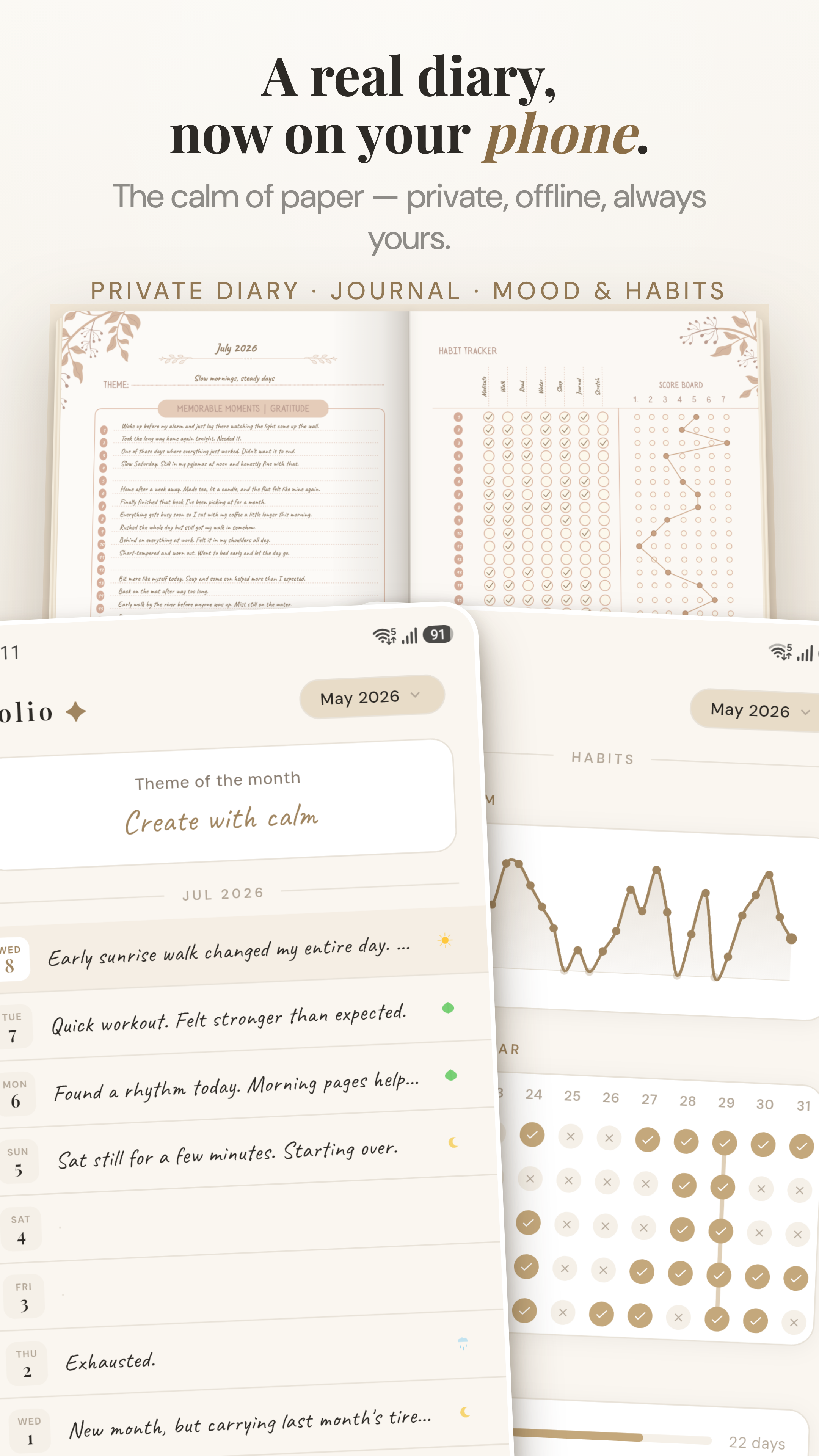
So we built Zolio (formerly Folio) around a simple promise: no matter how long you have been away, your journal should feel exactly as welcoming as it did on day one. You should never have to earn your way back.
Everything else is just how we keep that promise:
- No streaks, so there is nothing to break.
- One line is a complete entry.
- Missed days stay blank, never a red mark.
- Your month is there to remember, not to score.
Maybe you'll write tonight. Maybe you won't. Either way, tomorrow is still waiting, with a blank page and no penalty for the days you missed.
A journal should never make you earn your way back. It should simply be there when you need it.